

Why is news important? You have probably grown up with your dad reading the newspaper or your mom watching a morning news channel. Why do they care? Why should you care?
As we mature, our voice begins to matter, our vote counts and we begin to be a part of shaping the future. Whether that be the future of your education, your family or even our country, all of these decisions cannot be made without a basic understanding of current events. This is where news comes in.
It is essential to have factual information before taking it upon yourself to form an opinion or stance. Without it, we are highly susceptible to the bias of others and easily manipulated into misinformed mindsets.
So, where are students seeking news? Are they at all?
According to the World Press Institute, 51% of teenagers ages 14-18 reportedly get their news from social media, and of that 51%, 15% receive their news from TikTok.
The danger is not in the news itself, but in the algorithms that decide what you view on social media platforms like TikTok, Instagram and facebook.
A common phenomenon created by these algorithms is an echo chamber: “A social media echo chamber is when one experiences a biased, tailored media experience that eliminates opposing viewpoints and differing voices. Due to social media algorithms that ensure we only see media that fits our preferences, we have found ourselves in a comfortable, self-confirming feed,” according to the Stan Richards School of Advertising and Public Relations at the University of Texas at Austin.
These black holes of news limit the types of information we are receiving online, only feeding us what we want to hear. This limits our ability to decipher between varying sources and decreases our opportunities to understand opposing arguments and form our own opinions.
Aside from the danger of falling into echo chambers, getting news from social media poses another, if not more dangerous, threat: fake news.
On platforms like TikTok and Instagram, anyone can be a “journalist.” People can present extreme opinions as truth or post entirely false news with no factual standing.
According to UNESCO (United Nations Educational, Scientific and Cultural Organization), 62% of surveyed content creators reported they do not verify the accuracy of content before sharing it with their followers.
It is becoming increasingly more important for students to have access to reliable news, especially as they start to enter the workforce and gain the right to vote.
This information is not meant to discourage young adults, but to motivate them to fact-check news before jumping to conclusions, hopefully realizing the importance of breaking out of comfortable, agreeable cycles of bias while doing so.
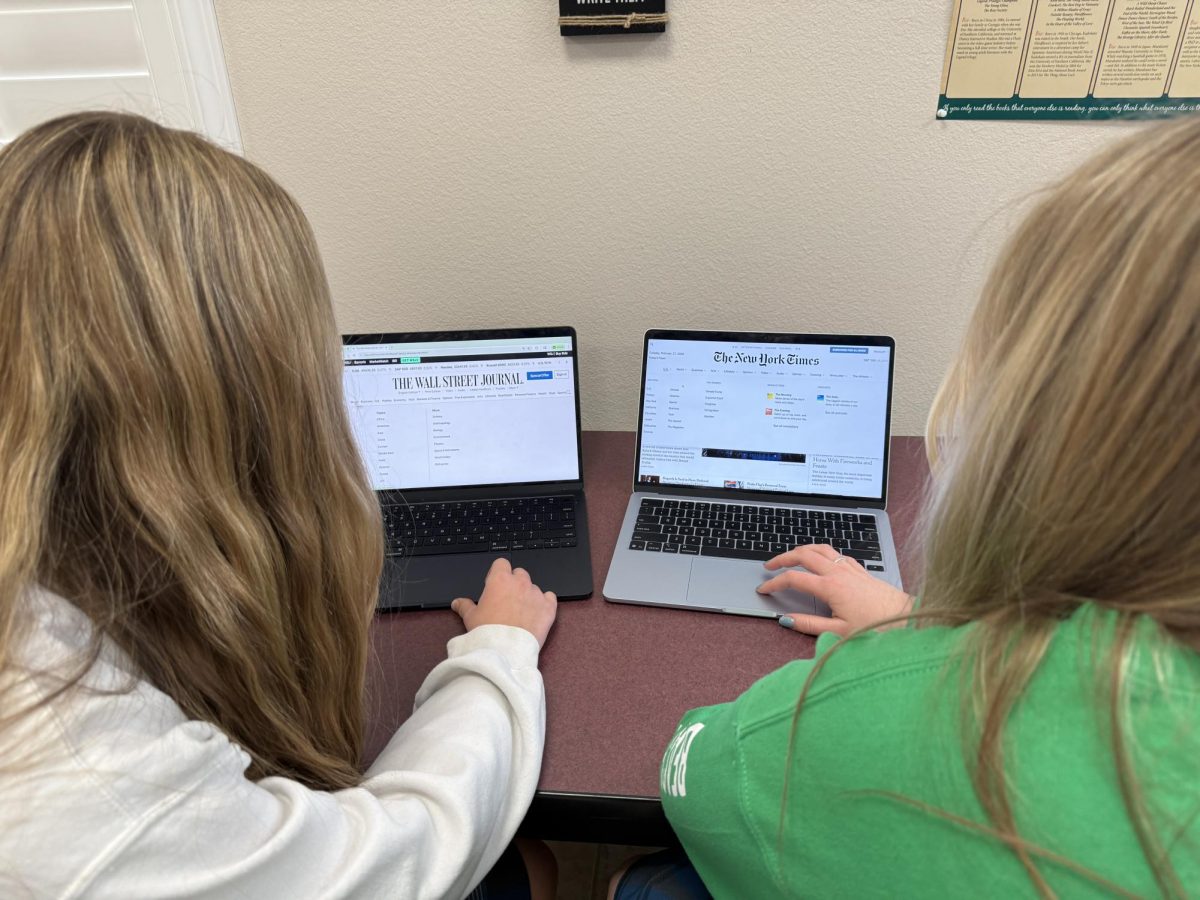
So, where to begin? A good first step is to reference multiple news sources in order to cultivate a well-rounded opinion on a situation.
My (Ellery) most dependable source I consistently consult for factual updates is “Unbiased Politics,” a podcast on Substack by lawyer Jordan Berman. Her legal background is helpful in not only explaining current events in an unbiased fashion, but also providing legal context into situations.
My (Lucia) most dependable source is NPR (National Public Radio). I find that listening to its daily broadcast on my way to school is a good way to keep up-to-date and get straight-foward reliable information.
But what’s most important is finding a way to get news that works for you. Yes, having a variety of sources is important to avoid bias, but finding a news source you trust is equally important.
Journalists are human, meaning bias is unavoidable when the source is not perfect, so research the background of your source to determine the type of bias your source has. Being aware is important.
So what does the rise of social media as a news source mean for journalism? Well, branding as a journalist is more important than ever.
Creating a relationship built on trust with readers ensures a journalist has a steady influx of viewers.
Nowadays there is a rise of independent journalism that corresponds to the decline of legacy media. Large, corporate outlets for news (legacy media) are commonly associated with a political party or perspective. For example, Fox News and The Wall Street Journal are historically right-leaning sources, whereas CBS News and The New York Times are historically left-leaning sources. An independent journalist, however, is one who is often reader-funded and has the ideological freedom that comes from not working under a corporation.
According to Megan Benan from the global analytics and advisory firm Gallup, only 28% of Americans trust newspapers, radio and television to report the news fully, accurately and fairly. This distrust between the media and its viewers has led to a decline in legacy media sales.
On the other hand, platforms such as Substack, where people can purchase a subscription from an independent journalist, grew 23.33 percent in 2024, according to PM Insights.
In a world full of biased noise, we encourage young adults to make an effort to educate themselves and learn how to form their own opinions based on facts. Our society can be a daunting and overwhelming place, but knowledge is a power we encourage all to take full advantage of.