
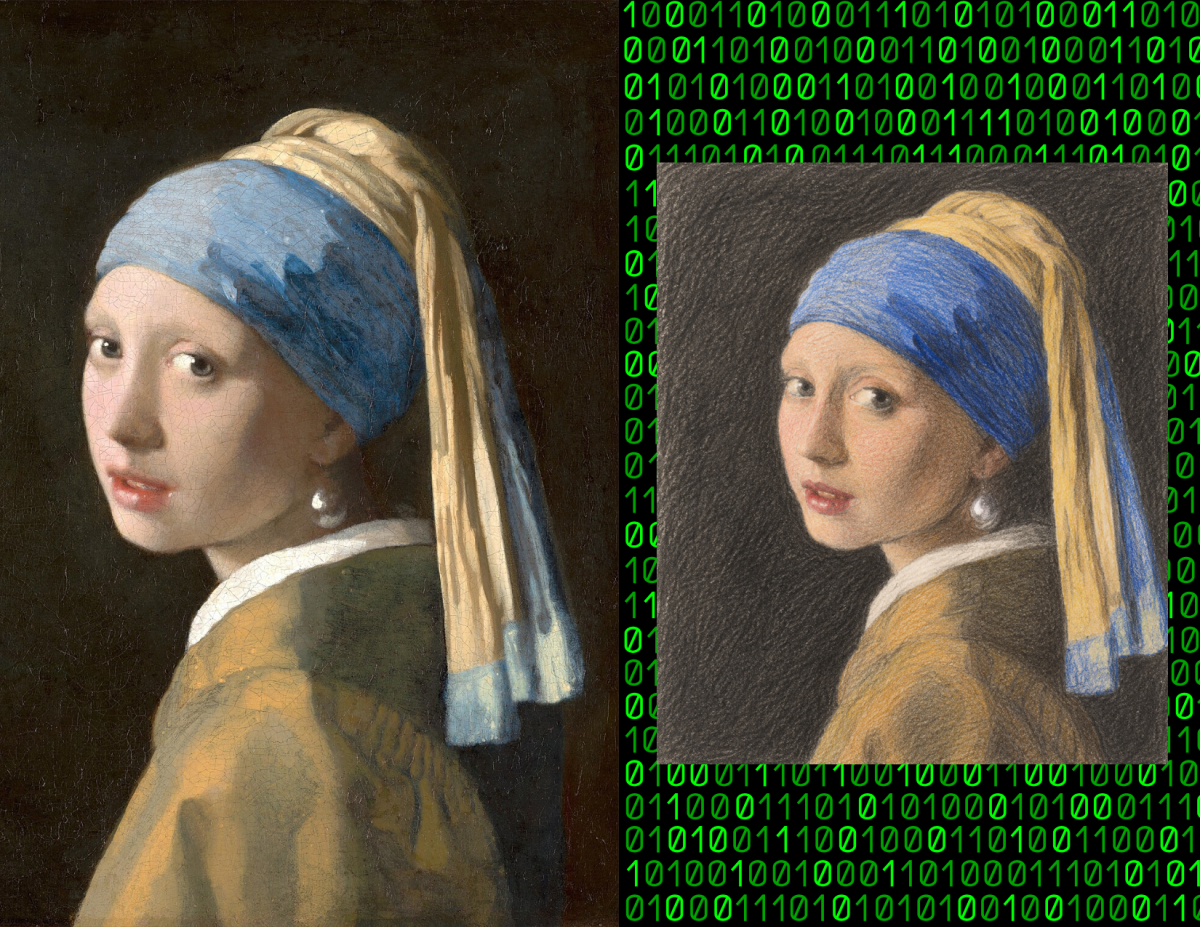
To many users, Artificial Intelligence (AI) is often seen as a revolutionary and transformative piece of technology. However, AI and its quick development have different abilities that many artists, performers and writers fear.
According to a May 20, 2025, article by Sachin Waikar for the Stanford Graduate School of Business, marketplaces selling art grew significantly with the introduction of AI.
It was revealed that 88% more marketplaces increased in activity with AI images than without AI images. The increase was caused by sellers using AI and resulted in a 23% drop in non-AI artists.
Sales have risen 39% after AI images arrived, while purchases of non-AI images dropped. To Xavier theatre teacher Sarah White, AI has no place in the arts.
“AI is a plague on creativity and the arts. It is stealing from humans and taking from creatives. The whole point of art is to relay and express the human condition,” White said.
AI is trained based on human-generated content from the web, meaning it is altering already made pieces and creating its own versions of it.
An October 2019 article by Ahmed Elgammal in the American Scientist magazine says that AI artwork comes from a collection of images put into an algorithm. The algorithms try to imitate these inputs which include photography, sculpture, paintings, film and music.
Many artists have filed lawsuits against AI companies arguing that the artists’ works are driving AI and they have yet to receive credit and compensation.
In the case of Andersen v. Stability AI, visual artist Sarah Andersen stood up against Stability AI claiming that the company unlawfully scraped about 5 million images from the Internet to train AI models.
As AI companies continue to use already-made work, it is only fair that artists should be compensated and acknowledged for their creativity.
For studio art teacher Alison Dunn, art is about the human experience and what’s processed through human senses, something AI doesn’t have.
“AI can’t imagine from the point of view of human experience. It lacks the spark of humanity,” Dunn said.
The use of online images, artwork and music for AI training could increase AI development, but at what cost?
We are seeing creatives turn to more “stable” industries due to concerns and fears about their work being dominated by AI. Artists are exploring more stable fields where human judgment, physical constraint and technical complexity are harder to automate.
Fine arts choir teacher Brittanie Hockins notes that she is already seeing the impact of AI on Xavier students and the art industry. “The past few years we have lost expression in the arts and the ability to have creative thought,” Hockins said.
In a world that is so focused on the advancement of technology and AI, it is more important than ever to keep the raw and real elements of human creativity alive.
Without artists’ passions to create, we would all live in a constant cycle of synthetic reproduction, never putting out anything new and original, leading to AI ultimately winning in the creative space.