



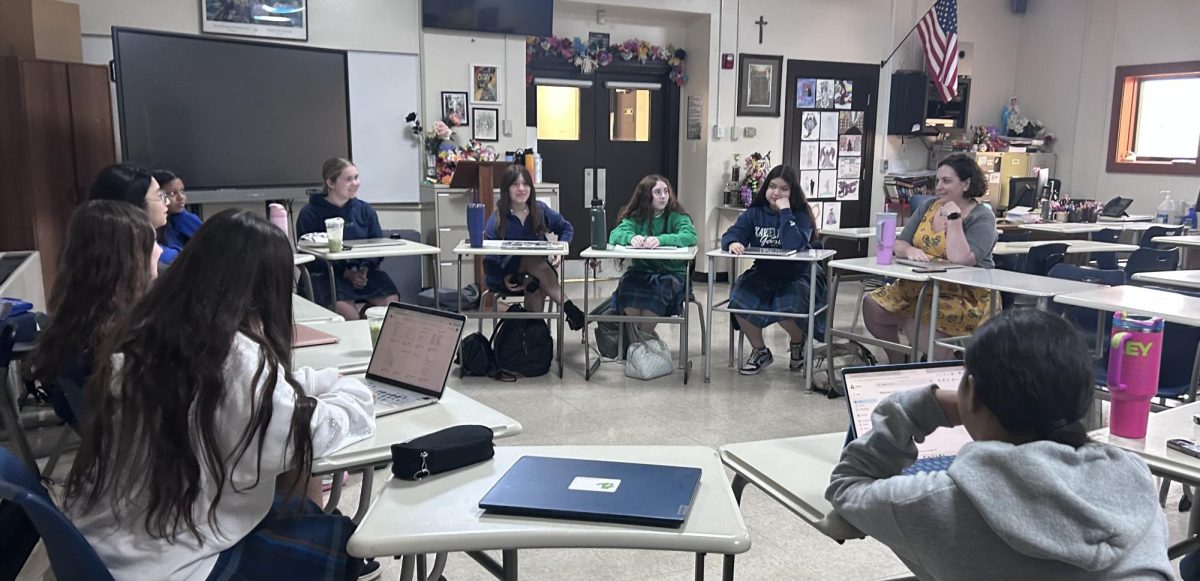
Xavier College Preparatory’s mock trial program has built a legacy defined by discipline, advocacy and sisterhood, earning recognition across Arizona for both its competitive success and its commitment to developing young women as future legal professionals.
Although the program began decades ago, mock trial was established with a clear purpose: to immerse students in the realities of the courtroom while fostering confidence, preparation and respect for the law. Over time, that mission has remained intact, even as the program evolved.
Today, Xavier’s mock trial team has been consistently among the strongest programs in the state. According to current Xavier coaches Rebecca Richter and Kate Boehm, Xavier has sent as many as four teams to the state competition. This is a rare achievement that reflects both the depth of the program and its emphasis on preparation.
While the size of the program has remained relatively constant in recent years, its internal structure has adapted to better support new members. One of the most significant recent developments is the creation of a scrimmage team, allowing beginners to learn procedures and strategy before competing at full tournaments.
“The biggest challenge with mock trial is that most students have never done anything like it before,” Richter said. “It’s confusing until you actually see it in action.” To address this learning curve, the program introduced the scrimmage team that now serves as a bridge between instruction and competition.
That emphasis on mentorship is mirrored in the student leadership. Current mock trial president Bri Blair ‘26 said the program’s culture is rooted in connection, not just competition.
“To me, the mock trial team is a strong sisterhood of tremendously intelligent and caring young women advocating for others,” Blair said. “Even though our cases are fake, everyone cares so deeply about fighting for their clients.”
Blair credits older students with shaping her own development. As a freshwoman, she relied heavily on upperclasswomen to learn application-based skills that cannot be mastered through instruction alone. That experience now informs her leadership philosophy.
As president, Blair has worked to strengthen connections not only within individual teams, but across the program’s four competing squads. She hopes future leaders continue building a culture where mentorship extends beyond assigned teams.
In addition to formal mentorship, the program has developed traditions that balance intensity with community, with public-speaking “scream practice,” where students project their arguments across campus to build volume, and “objection circle,” in which one attorney argues while teammates rapidly object from all sides to prepare for a courtroom.
The coaching philosophy at Xavier sets the program apart. Both Richter and Boehm emphasized their focus on realism over theatrics, prioritizing mastery of rules of evidence and courtroom procedure.
“We want our girls to be real attorneys,” Boehm said. “A lot of our students go on to law school. We want to prepare them for what actually works in a courtroom.”
That preparation is especially significant in a competitive landscape that has historically favored male-dominated teams. The two coaches acknowledge that sexism in judging has been an ongoing challenge, making preparation and precision even more essential.
Despite those challenges, Xavier’s mock trial program continues to thrive, supported by alumnae who return as assistant coaches and mentors. Their involvement helps preserve continuity while reinforcing the program’s values.
For Blair, mock trial’s impact extends far beyond trophies. “Advocacy is a skill we need more of in our society,” she said. “Young women are often encouraged to stay silent about injustice. Mock trial teaches us to speak.”